
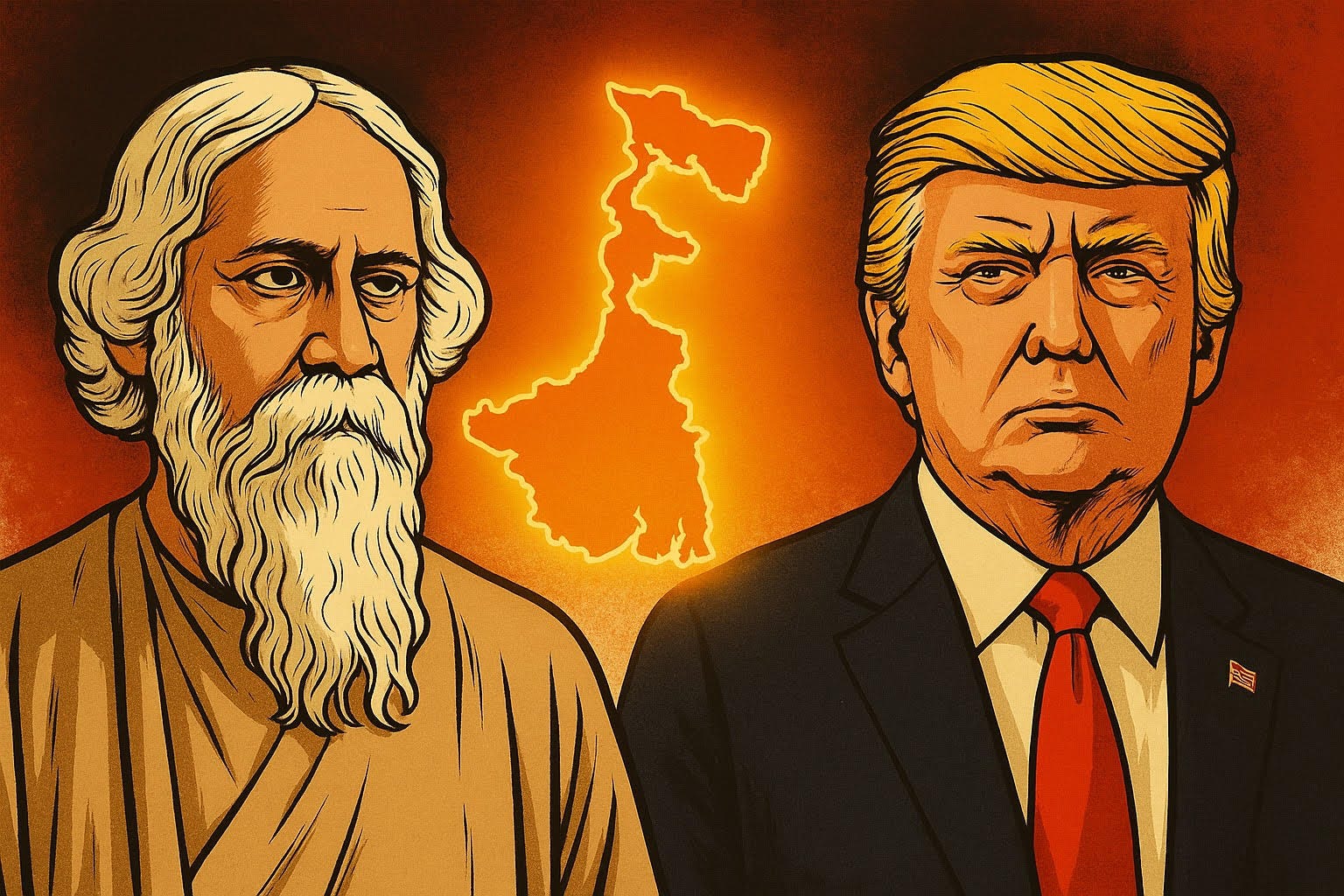
Last month during his address at the Operation Sindoor-themed Santosh Mitra Square Durga Puja pandal organised by Bharatiya Janata Party (BJP) leader Sajal Ghosh in central Kolkata, Union home minister Amit Shah said, ‘I prayed to the Mother Goddess so that West Bengal may get such a government after the elections, which may turn the state into Sonar Bangla. Our Bengal should once again become safe, prosperous, peaceful and sujalam suphalam (abounding in water and fruits).’
This is hardly the first time Shah has chosen to invoke the Tagorean Bengali cultural trope of Sonar Bangla (Golden Bengal) ahead of a key election in the state. In the build-up to the 2021 West Bengal Assembly polls, the second-most powerful leader in the BJP repeatedly promised to turn Bengal into Sonar Bangla. Unfortunately for Shah, the Bengalis were not interested that much in this proposition, as the Trinamool Congress (TMC) trounced the BJP in the ensuing election.
Of course, this slogan was not really the biggest reason why the BJP lost the polls where they had run a high-decibel campaign led by Prime Minister Narendra Modi. But the slogan failed to substantially boost their narrative amidst the TMC’s Bengali civic nationalist pitch, and this truth holds even today.
Sonar Bangla slogan’s unsuitability for Hindutva
When Bengali polymath Rabindranath Tagore wrote the song ‘Amar Sonar Bangla’ (My Golden Bengal) in 1905 as part of his participation in the Swadeshi Movement (which in turn was launched in response to the communally-motivated First Partition of Bengal), he intended to forge a civic Bengali identity, and 120 years later, the spirit of the phrase Sonar Bangla remains the same. When the Sonar Bangla pitch is raised, it essentially evokes two things in the Bengali cultural psyche. One is the Bengali ethnolinguistic identity — the word Bangla refers to both the Bengal region and the Bengali language — and the other is Tagore himself. And both the Bengali language and Tagore are invariably the sociopolitical territories of the TMC.
Why is that so? Because both the Bengali language and Tagore are deeply connected to a civic Bengali identity championed by the TMC, as opposed to the civilisational Bengali identity that the BJP wants to promote. By harping on the civic Bengali identity — which is what Sonar Bangla stands for — you can’t dethrone the TMC, for you can’t credibly claim to be better at Bengali civic nationalism than them. If anything, it will make you appear weak, desperate, reactive in the face of the TMC’s ethnolinguistic onslaught.
The importance of spiritual lexicon
Many believe that the social media performance of West Bengal BJP ahead of the upcoming Assembly polls is considerably better than it was before the same election five years ago. But there is one area where it can surely improve, and that is the use of spiritual lexicon. For example, consider the hashtag #MahilaBirodhiMamata (Anti-Women Mamata) that it has used to criticise the chief minister following her ‘girls should not be allowed to go outside of college at night’ remark on the Durgapur rape case. While #MahilaBirodhiMamata is not a bad hashtag, it is nowhere near as powerful and resonant as #NariBirodhiMamata. Mahila (woman) is merely a social category, while Nari (woman) is a sacral and civilisational identity.
A similar difference exists between the words Bangla and Bongo (both terms refer to the Bengal region, while Bangla also refers to the Bengali language). While there would be contexts where the BJP would need to use the word Bangla, it is strategically self-defeating for the party if it projects this word as its principal identity marker in the state. For harping on the sociolinguistic geography of Bangla is basically nourishing the narrative of the state’s ruling party. The word which should instead be at the centre of BJP’s electoral campaign in Bengal is Bongo, a term that is classical, timeless and spiritually vibrant, an expression that can help activate the civilisational memory of the Bengali populace.
Not here to fix Bengal, but to restore it — MAGA-style
The idea that Bengal is in a state of decadence — culturally, economically, intellectually — is widely held among the educated classes of the state. But being a national party often conflated with the Hindi belt, you can’t honourably claim to address this issue unless you are culturally sensitive AND emotionally resonant at the same time in your narrative. The BJP learnt this the hard way during the 2021 Assembly election when the TMC effectively portrayed it as a party of culturally regressive outsiders trying to ‘fix’ a culturally proud and progressive community.
Another problem with promising poriborton (change as a noun) or some variation of it (paltai or bodlai — change as a verb) is that this too is the natural political arena of the TMC. For Poriborton was a major political slogan for the Mamata Banerjee-led party when it ended the 34-year-long Left Front rule in 2011. The slogan of Poriborton still echoes in the political memory of the Bengali community. If the BJP merely promises change, it risks sounding unoriginal. In any case, Bengal does not need any more revolutions today, for what has brought about its downfall is its reckless uprisings that have weakened its connection to its glorious roots. What Bengal needs today is re-enchantment — with its own civilisational genius.
Therefore, it is important for the BJP this time to hammer home the idea that it is not here to fix, or to change, but to restore. Restore the Bengal Renaissance-era glory, the pre-independence dynamism, the era when Bengal was considered to be the most respected, the foremost, the greatest among all regions in the country. And this is where US President Donald Trump can help the BJP.
Bongo Abar Hobe Sera (Bengal Will Become the Best Again)
The belief that a community’s strength lies in recovering a lost moral-civilisational order rather than inventing a new one is something that has existed in world politics for long. Be it Shinzo Abe’s ‘Take Back Japan’ or Xi Jinping’s ‘The Great Rejuvenation of the Chinese Nation,’ restorationism has repeatedly been used as a political messaging weapon in the 21st century itself. But I have named Trump’s ‘Make America Great Again’ as the primary inspiration for my slogan suggestion for West Bengal BJP due to the semantic magnetism that the resulting pitch possesses.
The slogan Bongo Abar Hobe Sera — literally ‘Bengal Will Become the Best Again’ — taps into a real historical truth: there was indeed a time when Bengal was the best. Unlike Sonar Bangla which evokes ethnolinguistic poetic nostalgia, Bongo Abar Hobe Sera carries civilisational agency and motion. It’s a promise of restoration of power and glory, not a sentimental lamentation of loss of idyllic beauty.
Phonetically speaking, the slogan Bongo Abar Hobe Sera rolls off the tongue with a chant-like force. This makes it ideal for collective recitation and therefore a potent tool for political mobilisation. Imagine Prime Minister Modi addressing an election rally in Bengal, thundering, ‘Bongo Abar (Bengal Again)…,’ with the crowd completing the line in unison, ‘…Hobe Sera (Will Become the Best).’
I firmly believe that Bengal’s floundering destiny can be turned around only through a civilisational revival. And a civilisational revival requires not merely poetry but sanctity in speech. The Bengalis should not merely be made to feel like an ethnolinguistic group wistfully revisiting its lyrical past — they must be sonorously reminded that they are the blessed inheritors of the Bengal Renaissance. And that the august time has finally arrived to turn Bengal’s radiant memory of greatness into a triumphant mission of restoration.
(Originally published on X Articles on 22 October 2025.)